click image for Canvas textbook links

Last updated 05/04/2026 — accessed:
| Meets 11:00-12:15 Mon/Wed PHELP 1160 + TA sections Mon 2:00-2:50 ILP 4103 and Wed 5:00-5:50 ILP 3211 | |
|---|---|
|
(Prof.) Colin Allen
<colinallen@ucsb.edu>
|
Teaching Assistant:
Jon Charry
<jcharry@ucsb.edu> |
| Canvas site: https://ucsb.instructure.com/courses/32295 | |
This class introduces students to formal techniques for evaluating arguments. We cover a natural deduction system of sentential logic, truth-tables, a natural deduction system of first-order predicate logic, and the basic ideas of model theory. The application of these systems for analyzing arguments is discussed. Exams are designed to test skill with the formal systems, particularly translation from English to formulas, proof techniques, and methods for showing invalidity. There are no prerequisites for the course.
This is a FLIPPED class. Lectures are pre-recorded and must be watched before coming to class. You should read the corresponding part of the textbook and keep it handy before watching the videos. During class time we will work problems from the exercises in the corresponding sections of the book. Bring a laptop or tablet to class so you can use the online software designed to accompany the textbook. (See also the video introduction to using the website.) If you do not have a suitable device, the UCSB Basic Needs Program provides free tablets to qualified students.
By the end of the course, you should be competent with the formal methods introduced from Chapter 1 through to Chapter 6, section 2 of the textbook. If you have mastered the concepts underlying these methods you will be well-positioned to appreciate the significance of formal logic as a benchmark for argumentative rigor in fields as diverse as philosophy, law, mathematics, and science. You will also be in a position to understand the foundational role of logic for technological developments in computing hardware and software design.
The textbook for the course is Logic Primer, 3rd Edition by Colin Allen and Michael Hand. PDF of the book chapters are provided to you for your personal use via Canvas. Printed copies of the book are available from various online book vendors including the publisher MIT Press. The current printing of the 3rd edition contains some typographical errors. A webpage with the list of errata and PDFs of corrected pages is available at https://logic.tamu.edu/errata3.html. The PDF version in Canvas has all these fixed, but let your instructor know if you find others.
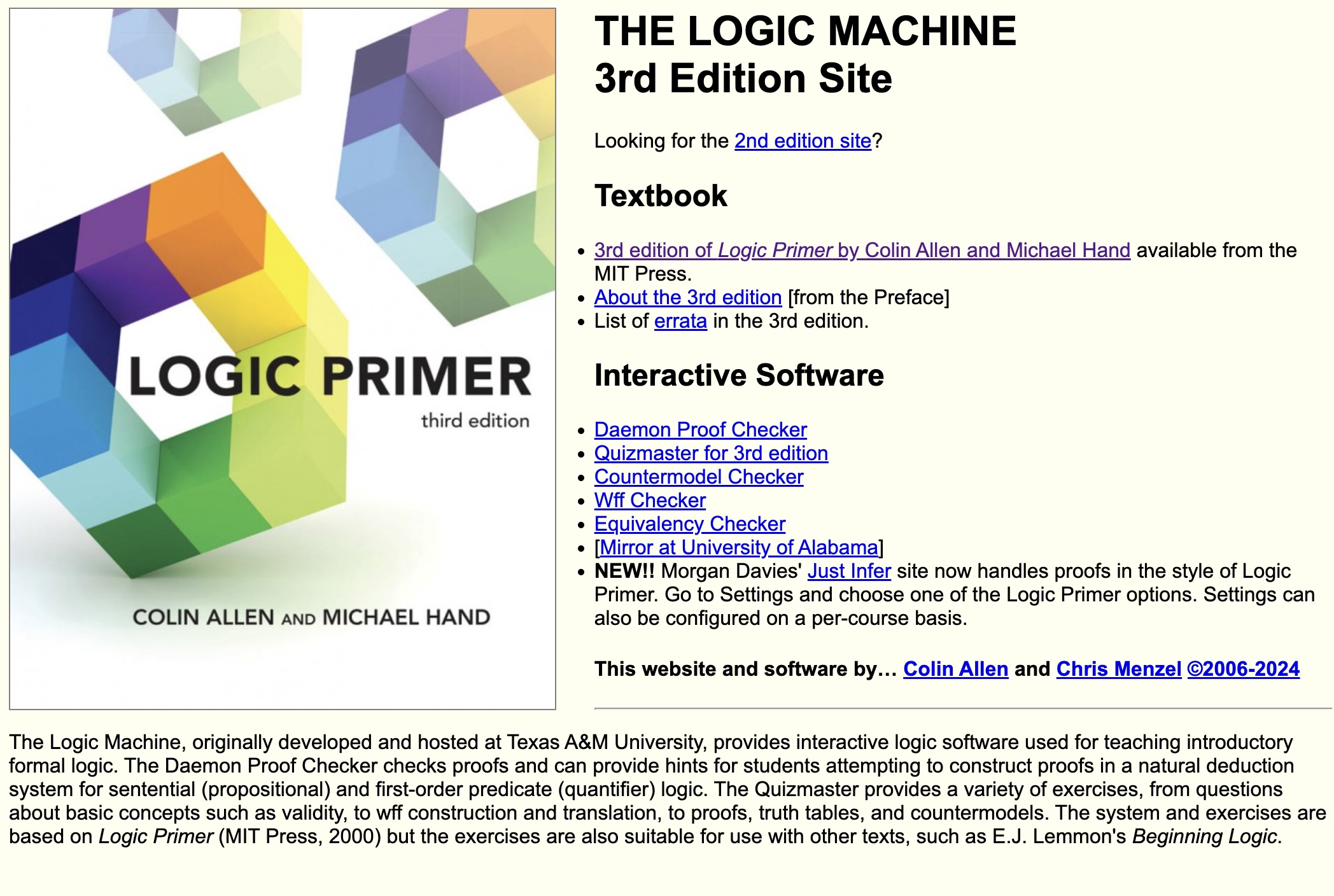
The Logic Daemon and Quizmaster website is freely available for you to practice the techniques and test yourself with exercises from the book and more. Using this website for practice will greatly improve your chance of success in the course. We will also be using this site during class time. A second website JustInfer written by UCSB graduate student Morgan Davies also supports the system of logic we will be using. Go to Settings and choose one of the Logic Primer options
Grades will be assigned on the basis of two midterms (during regular class each), final exam, and in-class quizzes. The quizzes are for extra credit and unless otherwise stated at the top of the quiz sheet, your response to the quiz questions must be perfect to receive credit (i.e., there will be no partial credit on quizzes). Quiz answers can be turned in immediately for double credit or taken home and turned in at the beginning of the next scheduled lecture for regular credit. Full regular credit will convert to a 4.5% boost for the course. Double credit can therefore be as high 9%, or nearly a full letter grade.
Your overall score will be computed using three methods and you will be assigned a grade based on the best of these methods.
For PHIL183 students, your overall score will be the best of these three methods and it will be converted to a letter grade according to the following scale: [100+:A+] [95-99:A] [90-94:A-] [87-89:B+] [84-86:B] [80-83:B-] [77-79:C+] [74-76:C] [70-73:C-] [65-69:D+] [60-64:D] [0-59:F]
For students in PHIL 283 (graduate credit), your best score will be converted to a letter grade according to the following scale: [104+:A+][100-103:A][95-99:A-][90-94:B+][87-89:B] [84-86:B-] [80-83:C+] [77-79:C][74-76:C-] [70-73:D+] [65-69:D] [0-64:F]
Implications of this grading scheme: If you are satisfied with your grade after midterms you won't need to take the final. If you have done poorly on earlier exams, you can still pull out an A by acing the comprehensive final exam. Try the PHIL 183 Grade calculator to see how it works -- plug in numbers and it will calculate the grade all three ways and show the best.
Bring your own paper for exams. (Blue books not required.) Midterms and finals will be open book and notes--but not open neighbor! No electronic devices allowed during exams. Midterm dates will be confirmed with 7 days notice. Numerical scores on midterms and finals will not be curved. Make up tests will be provided only in cases of authorized absence. See below for policy on missed in-class quizzes.
Attendance will not be formally monitored but quiz credit is available only for those attending class. Because all quizzes are for extra credit, no make-ups will be provided, although if you miss class you may obtain the quiz from a classmate and turn it in at the beginning of the next scheduled lecture.
The schedule shown is tentative. It is a good idea to read a section or two ahead of wherever we are in the class at that moment. The pace is high and it will be important for you to stay on track with the homework (ungraded) and quizzes (graded). Homework consists of all the exercises in the book. The "Quizmaster" section of the website at logic.tamu.edu contains the book's exercises as well as additional practice exercises.
| Date | Topic | Readings / Assignments |
|---|---|---|
| Week 1 | ||
| Mon Mar 30 | Introduction to the Course/Arguments, Validity, Soundness, and a Language for Sentential Logic | |
| Wed Apr 1 | Wffs and Translations | Read Ch1§§1-4; watch [1.1 basic logical notions], [1.2 vocabulary and expressions], [1.3 well-formed formulas], [1.4 English translations] |
| Week 2 | ||
| Mon Apr 6 | Translations / Primitive Rules of Proof | Read Ch2§1; watch [2.1a beginning proofs], [2.1b 3 more rules], [2.1c last 4 rules] |
| Wed Apr 8 | Proof Strategies / Derived Rules | Read Proof Strategies & Ch2§2; watch [2.2c derived rules] |
| Week 3 | ||
| Mon Apr 13 | Proof Strategies, More Rules, and Theorems | Read Ch2§§3; watch [2.3 Theorems] |
| Wed Apr 15 | Truth Tables for Sentences and Sequents |
Read Ch3§§1-4; watch
[3.1-2 Truth Tables],
[3.4 Indirect TTs
[note, there is no video for 3.3 by design]] |
| Week 4 | ||
| Mon Apr 20 | Direct and Indirect Truth Tables for Sequents | Read Ch3§5; Reread/rewatch all previous materials. Practice, practice, practice! |
| Wed Apr 22 | Review | Reread, rewatch everything; bring questions about unsolved problems to class. |
| Week 5 | ||
| Mon Apr 27 | First Midterm | EXAM |
| Wed Apr 29 | The Language of Predicate Logic | 4.1, 4.2 |
| Week 6 | ||
| Mon May 4 | Translations | 4.2 |
| Wed May 6 | Translations and Primitive Rules of Proofs | 4.2, 5.1 |
| Week 7 | ||
| Mon May 11 | More Rules of Proof | 5.2 |
| Wed May 13 | Finite Interpretations and Countermodels for One-Place Predicates | 6.1, 6.2 |
| Week 8 | ||
| Mon May 18 | Finite Countermodels for Multi-Place Predicates | 6.3 |
| Wed May 20 | Review | Chapters 3-6 |
| Week 9 | ||
| Mon May 25 | Memorial Day | no class |
| Wed May 27 | Second Midterm | EXAM |
| Week 10 | ||
| Mon Jun 1 | Review | All chapters |
| Wed Jun 3 | Review | All chapters |
| Finals Week | ||
| Thu Jun 11 | Comprehensive Final Exam 12-3 p.m. | Note time! |
The material below is generic to all my syllabi. Please ask if you are unsure how it applies to this class.
Except in Logic (PHIL 183), you may find my concise guides to reading philosophy and writing philosophy helpful. You may find them useful even if you are not so new to philosophy.
Undergraduate full time load at UCSB is a minimum of 12 units and an average of 15 units. Based on a 40-hour work week, this comes out to between 2.7 and 3.3 hours per credit hour per week. Thus, in a 3 unit course you should be spending roughly 9 hours per week on the course, and for a 4 unit course, it would be 12 hours. If your course meets for 75 minutes twice a week, that's 2.5 hrs of contact time leaving 6 to 9 hours per week of outside lecture time. If you have a discussion section, then one hour is allocated there, leaving 5 to 8 hours per week outside class. In other words, you should be spending 2 or more hours outside class on readings and assignments for every hour in class.
For those who do not own a portable computing device they can bring to class, the Basic Needs Resources office is able to provide Chromebooks at no cost, issued on a first-come first-serve basis for enrolled students who meet the eligibility criteria. They also have loaner laptops and iPads for students meeting the criteria.
Concerning note-taking and studying styles, you are advised to read these articles from the cognitive science of learning.
TLDR:
(1) taking notes on a keyboard is less effective than taking notes by hand;
(2) practicing recall via repeated testing is more effective than re-reading for long term retention;
(3) using LLMs to write essays has negative cognitive and neural consequences.
Except when indicated in the main part of the syllabus above, you may request to make up for missed exams or other assignments for and only for University-recognized officially excused absences:
Students in this course are obliged to comply with UCSB's Academic Integrity Policies. Any student suspected of violating this obligation for any reason during the quarter will be referred via the Academic Integrity procedures detailed at the above link. When you submit assignments with your name on them in this course, you are signifying that the work contained therein is all yours, unless otherwise cited or referenced. Any ideas or materials taken from another source for either written or oral use must be fully acknowledged. If you are unsure about the expectations for completing an assignment or taking a test or exam, be sure to seek clarification beforehand. Use of ChatGPT or similar generative AI products will be discussed in prior to any writing assigments, and may not be used unless you are explicitly given permission to do so, and never without explicit acknowledgment of its use.
The Americans with Disabilities Act (ADA) is a federal anti-discrimination statute that provides comprehensive civil rights protection for persons with disabilities. Among other things, this legislation requires that all students with disabilities be guaranteed a learning environment that provides for reasonable accommodation of their disabilities. If you have a disability for which you are or may be requesting an accommodation, you are encouraged to contact both your instructor and UCSB's Disabled Students Program for information about accomodations and services.
The University of California, in accordance with applicable federal and state laws and University policy, prohibits discrimination against or harassment of any person at the University on the basis of race, color, national origin, religion, sex, gender identity, pregnancy, physical or mental disability, medical condition (cancer-related or genetic characteristics), ancestry, marital status, sexual orientation, citizenship, or age. For more information see UCSB's Anti-Discrimination Policy page.
I ask that everyone in the class strive to help ensure that other members of this class can learn in a supportive and respectful environment. If there are instances of the aforementioned issues, you may contact the Title IX Office, by calling 805-893-2701 or visiting the UCSB title ix website. You may also choose to report this to a faculty/staff member; they may also be required to communicate about such issues to the University’s Office of Diversity and Incusion. If you wish to maintain complete confidentiality, you may also contact University Counseling & Psychological Services .
To ensure the free and open discussion of ideas, students may not record classroom lectures, discussion and/or activities without the advance written permission of the instructor, and any such recording properly approved in advance can be used solely for the student’s own private use.
Materials provided for the course may be protected by copyright. United States copyright law, 17 USC section 101, et seq., in addition to University policy and procedures, prohibit unauthorized duplication or retransmission of course materials. See Library of Congress Copyright Office and the University Copyright Policy.