
PHIL 1 — A Short Introduction to Philosophy — Spring 2026
Spring 2026 Syllabus and Schedule
Last updated May 8, 2026 — accessed:
Last updated May 8, 2026 — accessed:
Course Canvas site: https://ucsb.instructure.com/courses/32985
| Lecture Times/Location and Primary Instructor Information | |
|---|---|
|
(Prof.) Colin Allen
<colinallen@ucsb.edu>
|
|
| Teaching Assistants and Section Meeting Times/Locations | |

Eric Fossum <ericfossum@ucsb.edu> Sections: Tu 2:00- 2:50 ILP 4207 and W 2:00- 2:50 ILP 4105 Consultation hours: Tu 11:00-1:00 Location: SH 5702 |

Daehwi Jeong <daehwijeong@ucsb.edu> Sections: M 2:00-2:50 ILP 4101 and 3:00-3:50 ILP 3314 Consultation hours: Tu 3:30pm to 5:30 pm Location: SH 5706 |

Ka Chun "John" Mak <kmak@ucsb.edu> Sections: M 6:00- 6:50 ILP 3207 and T 10:00-10:50 ILP 3314 Consultation hours: Wed 2:00pm-4:00pm Location: SH 5702 |

Robert Zabel <zabel@umail.ucsb.edu> Sections: M 4:00-4:50 ILP 3101 and M 5:00-5:50 ILP 3211 Consultation hours: tba Location: tba |
This course exposes students to a sampling of topics addressed by philosophers, and provides an introduction to tools such as logic, definitions, counterexamples and thought experiments, that philosophers use to reason about complex and controversial claims.
By the end of the course, in addition to understanding the arguments that have been provided for and against prominent philosophical views, you are expected to be able to apply basic tools of argumentation, argument criticism, and conceptal clarification in your own writing about topics you have encountered in the class and to be able to apply these tools to examples of philosophical texts encountered for the first time.
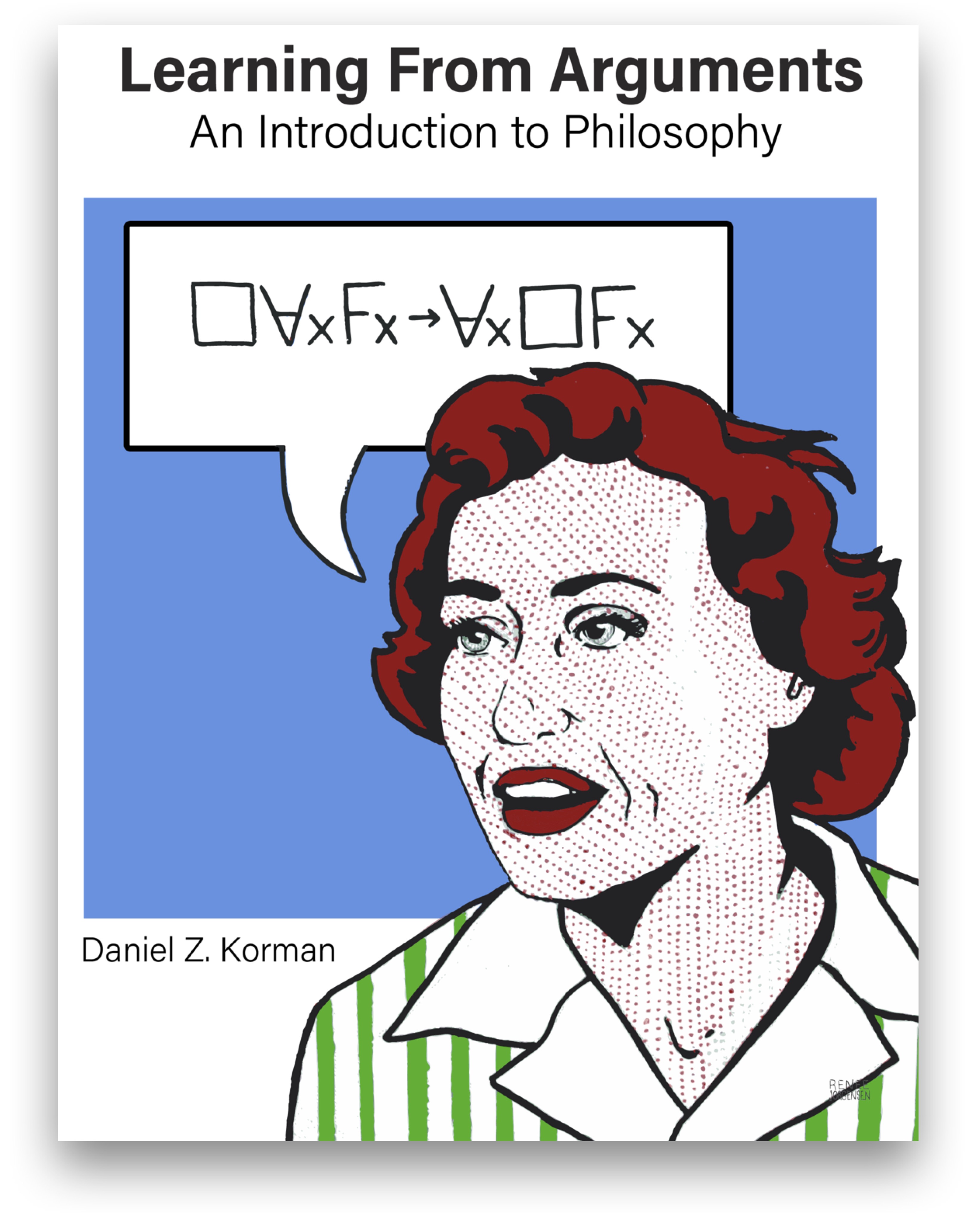
The textbook is Learning from Arguments: An Introduction to Philosophy written by UCSB professor Daniel Korman. The book is provided free of charge through Canvas. It can also be downloaded free of charge at https://philarchive.org/rec/KORLFA. If you want a printed and bound paperback copy you can buy it for $6.36 at Amazon.
We will not be covering all the chapters in the book, nor will we do them in order. The order of reading is Introduction-1-2-5-3-6-9-10. You should also read Appendices A and B during the first two weeks of the course. If you miss a class when the reading was assigned you should do it anyway because there may be a writing prompt or quiz on the earlier material.
Mon/Wed lectures will highlight aspects of the readings, provide important context, and introduce more ideas about how to respond to the arguments presented in the textbook. Come to class having already done the reading in the schedule for that date as you may be quizzed on the reading content.
Discussion sections will elaborate and clarify the main topics and you will work on applying the argumentative and analytical tools used in philosophy to develop your own positions on the issues covered in lecture and the book.
Time will be set aside up to two times per week in lectures and sections for short writing exercises of 15-20 minutes. Attendance is required to submit this work. See below for more information about how these factor into your grade and allowable absences.
Concerning note-taking and studying styles, you are advised to read the following two articles from the cognitive science of learning.
TLDR: (1) taking notes on a keyboard is less effective than taking notes by hand; (2) for long term retention, practicing recall via repeated testing is more effective than re-reading.
Except when required by a classroom activity, laptops and phones should be closed/off. I will stop and ask individual students to comply with this policy when I notice use outside these activities. Read this New York Times article about inability to concentrate to understand the basis for this policy.
Grades will be based on short writing assignments during lectures and sections (25% of the grade) along with occasional iClicker activities in main lecture (5%), an in-person midterm exam on Monday May 4 (30%), and final exam on Tuesday June 9, 12:00-3:00 p.m. (40%).
In-class writing assignments: 15-20 minutes will be set aside for these during main lecture or sections, 12-15 times during the quarter. Prompts will be based on previous lectures and readings scheduled before that class. You may have the text book and other paper notes open while writing, but no electronic devices. Your grade for these writings will be based on an average of the five best scores.
You may miss two without an excuse but a 3% deduction will be applied for each assignment missed after the second. (E.g., suppose you average A- or 92 points on your best five, but missed three total without an authorized absence for any of them, your aggregate score will be reduced to 89 or B+; if you missed four, then you'll receive 86, etc.) There will be no makeups given but if you have missed more than two in-class assignments then the penalty for missing them will be waived accordingly. See general policy on excused absences below the schedule. Do NOT email your instructors about absences unless you are about to miss your third assignment and have a legitimate excuse.
Exams: Exact formats of the midterm and final exam will be announced one week before each exam, but you should be prepared to answer multiple choice and short-answer questions about anything in the assigned readings or covered in lectures and sections prior to the exam. The final exam will also include once piece of previously unseen philosophical writing for you to analyze.
Various aspects of class participation will require you to use iClicker on a mobile device or laptop. The iClicker link for the course is https://join.iclicker.com/CHKY. (See UCSB's iClicker Cloud for Students guide if you need detailed instructions on how to set up your device.)
This reading schedule may be adjusted at any time. You will be alerted to changes via Canvas Announcements. You are expected to complete readings for a given date before class. If you miss classes, you should still do the reading before the next class as you are likely to be quizzed or asked to write about it.
| Date | Topic | Readings / Exams |
|---|---|---|
| Week 1 | ||
| Sections this week | Basic logical notions | Introduction §1-§4 + Appendix A §1-§2 |
| Mon 03/30 | Validity & Soundness of Arguments | Introduction §1-§4 + Appendix A §1-§2 |
| Wed 04/01 | Problem of Evil | Ch1 Can God Allow Suffering? §1-§3 + Appendix A |
| Week 2 | ||
| Sections this week | Argumentative Strategies / Problem of Evil | Introduction $sect;5-§7 + Ch1 Can God Allow Suffering? |
| Mon 04/06 | Problem of Evil | Ch1 Can God Allow Suffering? |
| Wed 04/08 | Religious Belief | Ch2 Betting on God §1-§3 |
| Week 3 | ||
| Sections this week | Philosophical Writing / Philosophy of Religion | Ch2 + Appendix B §1-§2 |
| Mon 04/13 | Belief | Ch2 Betting on God §4-§6 |
| Wed 04/15 | Free Will | Ch5 No Freedom |
| Week 4 | ||
| Sections this week | Free Will | Ch5 + Appendix B |
| Mon 04/20 | Free Will | Ch5 No Freedom |
| Wed 04/22 | Personal Identity | Ch3 What Makes You You? |
| Week 5 | ||
| Sections this week | Personal Identity + General Review | all previous readings |
| Mon 04/27 | What Makes You You? | Ch3 |
| Wed 04/29 | Review | all previous readings |
| Week 6 | ||
| Sections this week | New Skill: Extracting Arguments | Selection from Aquinas Summa Theologiae in Box; in Canvas |
| Mon 05/04 | MIDTERM exam | MIDTERM EXAM |
| Wed 05/06 | Epistemology | Ch6 You Know Nothing |
| Week 7 | ||
| Sections this week | Epistemology + argument extraction | Ch6 |
| Mon 05/11 | Epistemology | Ch6 You Know Nothing |
| Wed 05/13 | Animal Ethics | Ch9 Eating Animals |
| Week 8 | ||
| Sections this week | Applied + Extracting Arguments | Ch6 + Jeremy Bentham: Excerpt from Introduction to the Principles of Morals and Legislationin Box; in Canvas |
| Mon 05/18 | Animal Ethics | Ch9 Eating Animals |
| Wed 05/20 | Theoretical Ethics | Ch10 What Makes Things Right? |
| Week 9 | ||
| Sections this week | Theoretical Ethics | Ch9 + Ch10 |
| Mon 05/25 | Memorial Day | No class! |
| Wed 05/27 | Theoretical Ethics | Ch10 What Makes Things Right? |
| Week 10 | ||
| Sections this week | Review and Practice | |
| Mon 06/01 | Extracting arguments | Selection from Hume "Of Miracles" in Box; in Canvas |
| Wed 06/03 | Extracting arguments | Hume selection as above |
| Finals Week | ||
| Tue 06/09 | Final exam | FINAL EXAM 12:00 - 3:00 p.m. |
The material below is generic to all my syllabi. Please ask if you are unsure how it applies to this class.
Except in Logic (PHIL 183), you may find my concise guides to reading philosophy and writing philosophy helpful. You may find them useful even if you are not so new to philosophy.
Undergraduate full time load at UCSB is a minimum of 12 units and an average of 15 units. Based on a 40-hour work week, this comes out to between 2.7 and 3.3 hours per credit hour per week. Thus, in a 3 unit course you should be spending roughly 9 hours per week on the course, and for a 4 unit course, it would be 12 hours. If your course meets for 75 minutes twice a week, that's 2.5 hrs of contact time leaving 6 to 9 hours per week of outside lecture time. If you have a discussion section, then one hour is allocated there, leaving 5 to 8 hours per week outside class. In other words, you should be spending 2 or more hours outside class on readings and assignments for every hour in class.
For those who do not own a portable computing device they can bring to class, the Basic Needs Resources office is able to provide Chromebooks at no cost, issued on a first-come first-serve basis for enrolled students who meet the eligibility criteria. They also have loaner laptops and iPads for students meeting the criteria.
Concerning note-taking and studying styles, you are advised to read these articles from the cognitive science of learning.
TLDR:
(1) taking notes on a keyboard is less effective than taking notes by hand;
(2) practicing recall via repeated testing is more effective than re-reading for long term retention;
(3) using LLMs to write essays has negative cognitive and neural consequences.
Except when indicated in the main part of the syllabus above, you may request to make up for missed exams or other assignments for and only for University-recognized officially excused absences:
Students in this course are obliged to comply with UCSB's Academic Integrity Policies. Any student suspected of violating this obligation for any reason during the quarter will be referred via the Academic Integrity procedures detailed at the above link. When you submit assignments with your name on them in this course, you are signifying that the work contained therein is all yours, unless otherwise cited or referenced. Any ideas or materials taken from another source for either written or oral use must be fully acknowledged. If you are unsure about the expectations for completing an assignment or taking a test or exam, be sure to seek clarification beforehand. Use of ChatGPT or similar generative AI products will be discussed in prior to any writing assigments, and may not be used unless you are explicitly given permission to do so, and never without explicit acknowledgment of its use.
The Americans with Disabilities Act (ADA) is a federal anti-discrimination statute that provides comprehensive civil rights protection for persons with disabilities. Among other things, this legislation requires that all students with disabilities be guaranteed a learning environment that provides for reasonable accommodation of their disabilities. If you have a disability for which you are or may be requesting an accommodation, you are encouraged to contact both your instructor and UCSB's Disabled Students Program for information about accomodations and services.
The University of California, in accordance with applicable federal and state laws and University policy, prohibits discrimination against or harassment of any person at the University on the basis of race, color, national origin, religion, sex, gender identity, pregnancy, physical or mental disability, medical condition (cancer-related or genetic characteristics), ancestry, marital status, sexual orientation, citizenship, or age. For more information see UCSB's Anti-Discrimination Policy page.
I ask that everyone in the class strive to help ensure that other members of this class can learn in a supportive and respectful environment. If there are instances of the aforementioned issues, you may contact the Title IX Office, by calling 805-893-2701 or visiting the UCSB title ix website. You may also choose to report this to a faculty/staff member; they may also be required to communicate about such issues to the University’s Office of Diversity and Incusion. If you wish to maintain complete confidentiality, you may also contact University Counseling & Psychological Services .
To ensure the free and open discussion of ideas, students may not record classroom lectures, discussion and/or activities without the advance written permission of the instructor, and any such recording properly approved in advance can be used solely for the student’s own private use.
Materials provided for the course may be protected by copyright. United States copyright law, 17 USC section 101, et seq., in addition to University policy and procedures, prohibit unauthorized duplication or retransmission of course materials. See Library of Congress Copyright Office and the University Copyright Policy.